Sunday, April 5, 2026

Spring 2026

The standard 4-wire commercial tall-spindle system (click for larger view)

 The tall-spindle trellis system is finally finished and the trees are a'blooming! This is our second year (second leaf) and it is hard to believe that if all goes to plan we may actually get a few apples this fall. Apple trees bear on second year wood, but these trees still are so young it is hard to believe that they will produce anything. But that's the magic of the tall spindle system on dwarf root stock. Last summer after planting (first leaf), the trees did not bloom. That was a natural response due to being in cold storage.

Here we have one Ginger Gold (an earlier ripening version of Golden Delicious), one Macoun (similar to McIntosh), two Winecrisp, and one Dandy Red (a mutation of Paula Red/Summer Mac). This should give us a nice selection of varieties that can cross-pollinate and not come ripe all at once.

The master of the tall-spindle system in the US is the UMass extension agent, Jon Clements. Here he demonstrates a second leaf Honeycrisp planting.


Meanwhile, the winter rye cover crop on The Patch got a bit out of hand this spring. I finally had to weed-whack it so I can do a first till once things dry out a bit. I don't normally let it get over a few inches, but this spring was optimal for rapid growth. It almost was ready to start seeding out. The winter grain fields on local farms are extraordinary this year and our cover group was right up there with them. Lots of good green manure to enrich the soil.


Sunday, April 13, 2025

It's Apple Time!


For years I've been intrigued with intensive apple orchard systems I see in local orchards when I pass by, specifically the Tall Spindle system. So this year I thought I would give it a try. Assuming you start with two year stock, it is possible to get a small yield the second year. And being done with raspberries, renovating that bed for a small trial seemed like a good strategy.

Even though you don't do much to the trees the first year other than drip irrigation and bug control, this is a very intensive system requiring a lot of training and pruning in subsequent years.

For this small plot I went with Ginger Gold, Macoun, Winecrisp and Dandee Red. This is a good mix both for cross-pollination and a broad ripening window. All of these are grafted onto G11 dwarf root stock as only dwarf trees are compatible with the Tall Spindle system. And luckily we have one of the premier nurseries just up the road who supply quality bare root stock to commercial orchards and the backyard hobby farmer.

I'll let these get established for a few months and then start building the trellis.


Thursday, December 19, 2024

Year End Shutdown 2024


It was an uneventful season in the patch. And as in recent years, life just got too busy for more detailed postings on a regular basis. Time was better spent just keeping the crops rotated and in production.

But one highlight was experimenting with some open pollinated varieties of tomatoes and beans. The trials were interesting and I'll be posting more detail in 2025 on the ones I've selected for regular production.

Here's a view of the patch after our first dusting of snow for the season. The winter rye has sprouted and all that's left is a little kale, collards and the obligatory carrots for Christmas dinner next week.

Thursday, July 4, 2024

Mid-summer Goings On in The Patch


It's been a fairly uneventful spring and early summer around the patch. It was a wet spring so we were about two weeks late getting in and working things up. Even then it still was almost too damp to do a proper workup of our heavy clay soil. So there's lots of mini bricks that formed and will take a while to break down.

New this year is a trial of open pollenated beans and tomatoes. Those will be the topic of another post later on.


The big chore this year was renovating the strawberry patch. To maintain healthy plants and keep yields high, the patch needs to be completely replaced about every three to four years. In early April we planted 30 Sparkle plants from Johnny's. The key with a new bed is to watch closely and pinch off any flowers in May, and runners in mid-summer. this is so the mother plants can put all of their energy into establishing themselves. By mid-June, they are putting out three to four runners per plant per week. These need to be cut off, but you also can take the largest and healthiest and plant them between the mother plants to help fill in the row. These root quickly and once established the runner (umbilical) to the mother plant is cut away.


Once that's done, the only chore is to keep clipping additional runners and keep the bed watered, weeded and fertilized. In late fall it will be strawed in and ready for winter.


Saturday, November 18, 2023

Year End Shutdown 2023


Overall, it was a good and productive year. All that remains are a few carrots and beets. The rest of the patch received a light till to knock down the late season weeds, and a top dressing of shredded leaves. No winter rye this year as we needed a place to park the leaves over the winter. In other news, the strawberry patch was tilled in preparation for a renovation next spring.

Friday, June 16, 2023

Stalag XIII


While we've been very lucky over the years with only small varmints attacking the patch (rabbits and ground hogs), the last couple of years has seen our first deer damage. It used to be primarily in the fall as the local herds churned due to the rut and hunting. But now it's all seasons. 

Time had finally come for a proper ag quality perimeter fence. It was a three day operation with corner posts installed and a QFE entrance gate constructed. But glad it's done. In retrospect we should have done this twenty years ago.


Sunday, December 18, 2022

A Slight Change of Pace


We haven't bothered with a natural Christmas tree since the kids were babies. Back then it was a big deal to load everyone up and head to a local tree farm to slay that perfect specimen. But after a nearly twenty year hiatus with an artificial tree, the time has come to venture out to Smithsburg and bring back a local fir for the homestead. It also gave the Number One Daughter a chance to dirty up her tires and haul an actual agricultural load in her new pick up truck.

While modern LED light strings are both energy efficient and much safer to use on live trees, I pulled out my old tree juice recipe. It was from a newspaper clipping from way back in the early 1990s.

First, cut a live tree so you know exactly how old it is and where it came from. Go ahead and have it bailed, and as soon as you get home, stick it in a five gallon bucket with a solution containing the following ingredients (mixed well):

2 gallons of hot water

1 pint of clear corn syrup (any brand will do)

4 oz of liquid bleach

2 oz of apple cider vinegar

1/2 tsp of borax powder

2 oz of liquid Woolite laundry soap

Store your tree in a protected spot out of direct sun (back patio, un-heated garage, etc.) for four to five days. It's best not to allow the bucket to freeze tight, but an overnight glaze of ice on the surface is fine. As long as the stump remains submerged in the solution.

On the day you plan to bring it inside, first cut off an inch or so of the stump to expose a fresh surface that hasn't sealed over with pitch. Then un-bail the tree and do whatever lower branch trimming is needed to fit it in your tree stand. This is also a good time to trim away rough areas and give the tree one last shake to remove loose needles and dormant critters. If you plan to keep the tree inside for more than two weeks, you also may want to spray it with an anti-desiccant like Bonide Wilt Stop. But you'll need to allow it to dry completely before moving inside. And the anti-desiccant will decrease that wonderful Christmas tree smell that is the main reason for going with a natural tree in the first place.

Once inside and in its final location, be sure to add fresh tree juice to the stand. And never let the juice level drop below the surface of the cut. If all goes to plan, the original two gallon batch should provide enough juice to get you through a two week celebration. But be ready to whip up another smaller batch (decreasing the ingredients proportionally). Or if you find yourself running out of juice with only a few days left until New Years Day, plain water is fine. Just never let the stand dry out to the point where the stump is not immersed in some kind of fluid.

Growing up in Virginia in the 1960s-70s we always put our live tree up on Christmas Eve and took it down on New Year's Day. But today people put up trees way too early. We can only hope they are using artificial trees or otherwise being very careful against fire.

Over the years we've struggled with all sorts of plastic tree stands, but this steel model is the best by far. It's beefy, and has a spike in the bottom to keep the stump from lateral movements once the four screw pins are tight. It also holds about a half gallon of tree juice.


And the final product!!! Merry Christmas!


Wednesday, November 16, 2022

Season Wrap Up 2022


Last of the fall crops amongst the winter rye cover 

2022 was a typical season. We had two short dry periods that required a couple of days of irrigation but no major droughts to contend with. All and all it was a good year.

However, we did have a few more visitors this season. A rabbit that required relocation and some migrating deer. If you click on this picture to enlarge and look very closely, you will see two youngsters who happened by one August morning. I was only able to grab this one pic before they bolted never to be seen again.

Beets destined for the pickle jar. And some mid summer flowers elsewhere in the yard.


Sunday, July 17, 2022

We got your pickled beets right here!


It's pickle beet time! Since the half row was doing so well and we just couldn't eat beets every night of the week, I figured it was time to make pickle. Using my mom's (and her mom's before her) recipe.

Topped.

Washed.

All the cooking and canning are done in the garage. But the pickle syrup was made in the house. Man it smelled just like grandma's house.


And there you go; four quarts and 12 pints.


Monday, March 28, 2022

More Early Spring Activities


After the initial work up last week of the winter rye cover crop, it was time to work in some mushroom soil. Here is what two yards looks like when spread out just before tilling.

And this is after two perpendicular passes with the tiller. After it sits for a week or two to give the rye time to rot in, it should be good to go.


And time to edge the strawberry bed. Once the crowns take off the sides will be filled in with straw.


The weeping cherry is in full bloom and the honey bees are really going after it.


 But it's still a bit early for the fruit cherries to be in bloom. This is a good thing as we're having a late hard freeze tonight. These are buds on the Regina tree which is now five years old and about fifteen feet tall. Unfortunately, it requires a pollinator, and the Blackgold we planted next to it died two years ago. It was replaced with two more last summer. Not sure if we'll get any fruit this season or not.

Wednesday, March 23, 2022

UPDATE: More COVID-1984

 While the COVID-1984 lockdown madness has been interesting to say the least, working from home full-time has totally changed the gardening process. The biggest change being able to keep a closer eye on things like applying organic pest control on an almost daily basis (due to poor persistence and rain shower wash-off). And slipping out at lunch time to do some daily weed pulls. This makes weekend maintenance much easier.

The first year (2020) was novel enough to keep me motivated. But as the pandemic dragged into the 2021 growing season, I got a bit lazy with secession planting and maximizing output. And I just didn't have the enthusiasm to do any posts. But as Biden-flation rears its ugly head, I hope to do a better job this season of keeping all aspects of the patch in full production.

So yesterday (March 23) was the first turn over of the over-wintered rye cover crop. The key to this process is to cut back the growth before attempting to till. Otherwise you get a mess tightly wrapped around the tiller tines and a gumming up of the whole process. I used the weed whacker to make quick work of this. Then its two rounds with the tiller.

Before and after shots.


Sunday, December 13, 2020

End of Season 2020


Furnace filters replaced, check; water filter replaced, check; drains cleared, check; septic tank pumped out, check; outdoor power equipment cleaned and serviced, check; garden cleared, cultivated and over-seeded with winter rye, check. We are ready for winter!

With COVID and forced telework, this was the first season I was able to go with total organic pest control. There is nothing like keeping a daily check on the patch and reapplying various organic sprays exactly when needed. All and all if was an excellent season.

The last remaining crop for winter is our kale. This year we planted a full row of Lacinato and a second row of Dazzling Blue, Red Russian and Premier COL (one third of each) in late August so it would be up and well on its way by heavy frost. Last year our crop was nipped by an early heavy freeze before it had a chance to harden off to the colder weather. This year we were careful to get it up and under row cover before the heavier frosts.

Since kale can take some pretty cold temps, the row cover is little more than insect grade Agribon. Just enough protection to hold off the worst of the freeze and still provide some heat retention and good light transmission. This usually keeps us with kale well into January.

Wednesday, August 12, 2020

Late Summer Goings on in The Patch


I saved the Indian corn from last year's Thanskgiving table decorations to see what kind of yield I would get; planting four short rows at high density (two of the dark maroon, and two of the tri-color; selecting seeds that were more on the dark purple side). Damn, every kernel sprouted, and most stalks have at least two good ears forming up. And unlike the modern field hybrids, some of these have topped off at 12 ft.!!!! But there is a lot of variation in individual phenotype. Some of the stalks are stunted, have weird ear formations or were so weak as to fall over. This is not unexpected for wild open-pollinated varieties. I can't wait to see what kind of total yield I get and most will be ground for meal but some saved for this year's fall decorations or to give away. 

Indian corn (aka flint corn, native corn, etc.) was the primary corn of my Virginia dirt farmer ancestors. There really was no modern hybrid corn like we see today until after the Civil War.

Here in late summer the really good news is that Japanese beetle season has finally ended; yeah! It is always a battle with these guys. But this year with me being on extended telework due to RONA, I was able to keep a close eye on the bait trap and actually have time to do daily hand picks and almost daily spraying. Organic sprays are nice, but there is little to no persistence especially following rain. I've never been home every day before so this certainly has been a unique garden season. I'm hoping by increasing the diligence this season and applying milky spore under the most susceptible plants, maybe we'll be able to finally tune these pests down a bit. I also hit the ornamental (weeping) cherry with a commercial systemic pesticide this year. The protective effect was miraculous. But you can't use that on anything destined for fruit consumption.


And I was bound and determined to keep the aphids and cucumber beetles under control this year. A combination spray of Neem oil and insecticidal soap applied every three days or so and once a week spinosad seemed to do the trick. So for once we got a full season worth of cucs and squash out of one planting. I suspect too that taking a rest year off last season may have helped break their reproductive cycle. And there is nothing like being able to pick the best-of-the-best for a batch of homofermentative dills. And just in time for the first dill heads to go to seed. Can't wait to crack these open.

So all and all its been an interesting season. For the first time in 18 years I was available to run out and do daily maintenance. Only a few minutes between conference calls or for longer periods over lunch meant a vast increase in the quality of produce and not letting the weeds and other things get out of control. I am very grateful to have had this once in a (working man's) lifetime opportunity.

Soon it will be time to prepare the early spring rows for the fall and winter crops. Already we have broccoli and cauliflower seedlings almost ready for sitting out. The fall carrots and beets were planted this week, and it won't be long before the kale rows are prepared. These will be staggered so as to have health near-mature plants ready by the first heavy frost of the fall. Then they will go under a row cover for winter time greens.


Monday, May 11, 2020

Renovation of the Compost Bin


I finally got around to switching out the compost bin this past weekend. Originally it was a circular structure about two yards in diameter made of 2X4 fencing with a couple of feet of rat wire around the bottom to hold in the small material after breakdown. This served us well for nearly 18 years as a fill and forget (no turn) bin system. The new bin was made of three untreated skids with the lower slits covered over with planks from a fourth skid. The front was closed off with a section of the old bin held in place with two T-posts.

But I thought it was time to give this a bit more attention and convert over to a bin that is turned on a regular basis. This switch out was only the second time in 18 years that I've harvested true compost. After removing the top foot or so of undigested material I was able to pull out 8 wheelbarrow loads of good quality compost. This went directly to the main patch for augmenting the soil.

Other than that, the weather continues to be unusually cold with two nights this past weekend getting down to freezing. This most likely will lead to some loss of strawberry blossoms. But since they are so thick, a little thinning might be good.

Saturday, April 18, 2020

Spring Time Check In (Rona Edition)


Spring has sprung and a new garden season is underway. After taking off last year to give the beds a much needed rest, this year will be especially important to get back into the hang of seed starting, crop rotation and enhanced production through succession planting.

I say "enhanced production" because with the currently raging COVID pandemic (aka "The Rona"; aka Wuhan Red DeathCCP Virus, Wuhan Lung AIDS, Kung-fu Flu, Chinese Lung Clap, Chinese Bat Cancer, Chinese Lung Crud, all courtesy of the Rott) the latest contagion to crawl out of the  Chinese petri dish, we'll be needing all of the fresh veggie supplementation we can grow over the next few months.

Last summer there were three superficial tills of the beds to suppress weeds and keep our notorious clay soil workable, followed by over seeding with winter rye. After the last till, I over seeded the main plot with buckwheat. This was a spectacular cover crop that was left in place to die down and overwinter. And back in February that too was worked in.

Right now we have a very early crop of mini bok choy, mustard greens and (not pictured) a couple of broccoli. Soon to be followed with more greens and lettuce. Kale and chard were direct seeded last weekend but with the temperature drop these will be delayed a bit. And by May we should be starting tomato and pepper seeds indoors together with more direct seeding outside of squash, beans and cucs.


The other big chores last weekend was to do a final straw-in of the strawberry bed that was established last season. This will be the first time doing this in one of the long beds which should make harvesting a lot easier than doing a big bed in the main plot. I also planted the new raspberry sets in their bed. This time around there were five "Jewel" black (summer bearing) and five "Anne" yellow (ever bearing). These will be ready for first crop next summer.

Other spring time beauties around the compound (as always click on the pic for a larger view):


Heartleaf Brunnera


Regina cherry


Red Bud

Sunday, October 20, 2019

Fall 2019 in The Patch


The late summer planting of buckwheat did its duty and just last week we mowed it over. The growth was incredibly vigirous and reached almost three feet in places. But the rains knocked much of it over. We'll leave it just like this as a good winter cover until the first spring work up.


The raspberry bed's first winter off is serving as our kale and collard patch with some Asian mustard greens on one end to get us into late fall. Once the hard freezes arrive we'll put a spun fiber cover on the kale and collards to minimize winter deep freeze damage.


There's really nothing like running out to the garden and grabbing a Nappa cabbage and some Asian and mustard greens and doing a quick stir fry. The precise reason why everyone should have a kitchen garden!

Monday, August 19, 2019

Summer 2019; A Well-Deserved Rest


As planned back in the winter, this was to be the first "rest" season for The Patch in nearly fifteen years of constant production. Beginning with the spring work up, I went through three separate plantings of winter rye followed each time by a shallow till once the growth was up to about four to six inches in height. This did a fairly decent job of keeping down the weeds although I had to resort to some limited hand weeding last month as the summer heat brought out the worst of the crab grass and purslane. I'm always amazed at just how fast purslane grows under near drought conditions and the volume of biomass that is produced by just one plant. Apparently it is a highly nutritious edible but I have yet to give it a try.

Following the last rye work-up two weeks ago I over seeded with 10 lbs of buckwheat. This is my first time using this cover crop. It sprouts almost overnight and quickly reaches a foot in height. Our stand is about to bloom where it will double as bee forage. Buckwheat is an annual and highly frost sensitive so it will remain in place until late fall. At that point, after it dies down, I'll decide whether to work it in with the fall leaves or just leave in place until spring. Depending on how strong the stems wind up being it may require a light mow first. We shall see. Regardless, cover cropping not only helps maintain soil structure and stability, but it also acts as a host for beneficial arbuscular mycorrhizal (AM) fungi. As a microbiologist I've been researching this topic the last few weeks and will have a post on it soon. Although I have no formal training in agricultural micro, I'm amazed by just how little we really know about beneficial symbionts and the greater plant microbiome.


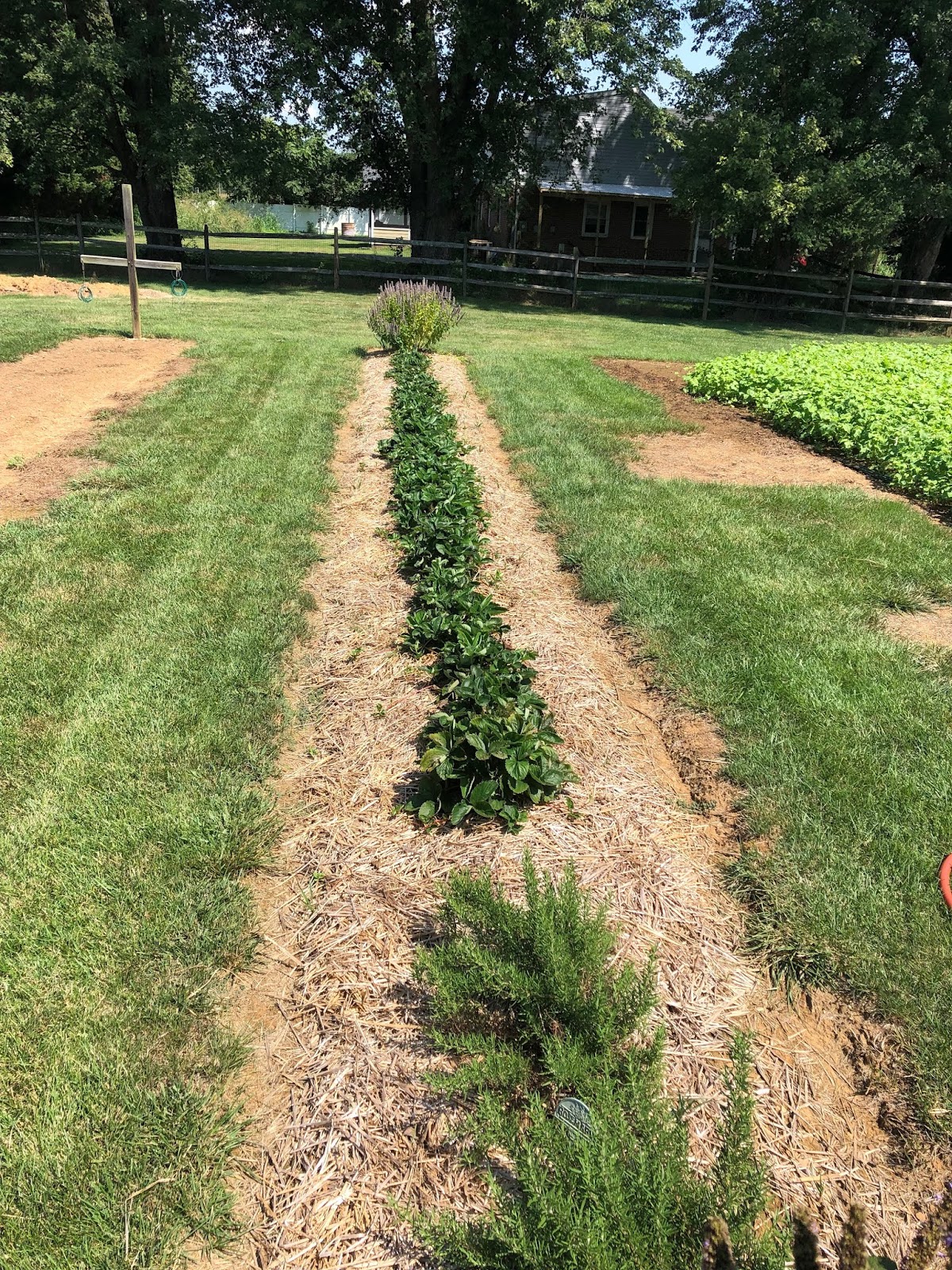
We also decided to re-establish our strawberry bed in the long row this time around; making picking a lot easier next spring. It will also be easier to apply the bird block mesh in this kind of row configuration. After three cycles of work up they were finally mulched with straw. So now its a matter of keeping the side leaders cut back but allowing them to fill in between the mother plants. These were "Galletta" plants from Burpee. So far they have been very vigorous with no sign of fungal outbreaks. All 25 plants in the bundle survived.

Besides cover cropping and strawberries the only other real plantings were a couple of rosemary plants for fresh kitchen use and maintenance of five red bud trees for transplant into our wild border next spring.

The raspberry bed received the same rye cover cropping as the main bed but didn't get any buckwheat as this bed will be planted in a few days with fall greens and lots of kale for over wintering. Next spring we will once again establish a new bed of raspberries.

Sunday, January 20, 2019

2018 Season Wrap Up; Monsoon Edition

Nothing like waiting a year (almost to the day) to update what normally is a fairly active blog. Postings were nonexistent for a number of reasons; busy schedules, etc., etc., etc. But mainly due to the strange weather year and crappy growing season we had in 2018. With the light table upgrade it was supposed to be the best season ever; right? Being able to produce all sorts of seedlings under commercial grade plant lights. Unfortunately not!

The Washington County precipitation record still stands at 76.6 inches (1996) while 2018 went down at 67.1. We moved here in 2002 and there is water laying in fields and flowing across back roads, to this day, that I have never seen before. The ground was saturated by mid summer and now we have a slight snow pack. All liquid water now must find its way to the lowest point. Except for evaporation, there is no place else for it to go.

It took forever to get into the garden last spring to do the first till. The strawberry crop rotted in place, and the bug populations exploded. Trying to use organic spays would have meant having to apply them almost nightly. I finally had to resort to a commercial orchard spray to keep the cherry trees from total destruction. Even something as basic as succession planting for lettuce was DOA. The only consultation prize was a very good crop of summer squash. With just enough break in the monsoons I managed to get in six hills; three yellow and three green zucchini. We managed almost a full month of stir fry once they started to come in.

So if it ever dries out enough this spring to till, the strawberry bed will be moved to the long bed. The raspberry bed was due for renovation anyway so that will get some rest. And after fifteen years of constant cultivation, the majority of the Food Patch will be taking a well deserved year off in 2019 for rest and solarization. The raspberry and big beds in particular. The long bed will be used to "hopefully" re-establish a strawberry bed and for salad greens, maybe. For this round the strawberries will go into proper row fabric to control weeds.


Meanwhile, as an experiment I raised a flat of mini romaine lettuce on the light rack. The seeds went in the week of Dec 10 and are ready to harvest this week. I also have a couple of seed blends for microgreen production that I want to give a try as an addition to commercial salad mixes.